In an old Cape suburb, half the shading is finished before anybody fits a blind. A hundred-year-old oak does it. A neighbour's pine does it. A wall that has been standing in the way since the fifties does it. Sunningdale has almost none of that, because Sunningdale is barely twenty years old and the phases are still going up. The gardens are young, the stands are tight, the glass is enormous and there is nothing at all between it and the sky. Everything that shades a house in this suburb has to be put there on purpose — so it is worth putting the right thing on the right wall, in the right order.
Everything below is in a single PDF if you would rather save it than scroll.
One
A young suburb owns none of its shade
Sunningdale is Garden Cities' flagship suburb on the West Coast, and the developer is plain about its age: the first phases went in just over twenty years ago, there was a pause while the city's infrastructure caught up, and homes are still being built in the newer phases today.1 It sits on the Western Seaboard between Table View and Parklands.2
That timeline is the single most useful fact about shading a house here. Trees planted with the house are still ten or fifteen years away from throwing usable shade over a first-floor window. Boundary walls are low enough to keep a street feeling open. And the land itself is flat — this is the Blaauwberg plain, not a mountain slope — so there is no ridge to put your western glass into shadow at five o'clock the way the suburbs across the bay get for free.
In Sunningdale the sun stays on your glass all the way to the horizon. Nothing takes it away early.
So the brief here is not the usual one. It is not "soften what's left of the light". It is "build the shade the suburb hasn't grown yet" — and do it in a way an architectural guideline will still be happy with in ten years.
Two
Where the sun comes from here, and at what hour
Two numbers per season are enough to plan a whole house. Published sun-path data for Cape Town puts the midwinter noon sun at roughly 31 degrees above the horizon, setting on a bearing of about 295 degrees; at midsummer the noon sun is up at about 75 degrees and sets on a bearing near 240.3
Read those bearings again, because they surprise most people. In June the sun sets north of west. In December it sets south of west. So the elevation that takes the summer beating is not simply "the west wall" — it is the face that runs from west round toward south-west, and it takes the beam almost horizontally from mid-afternoon until a sunset that comes well after seven.
The other half of it matters just as much: the low winter sun arrives from the north, it is weak, and it is welcome. A north-facing living room in Sunningdale is a genuine asset in July. Any specification that darkens it permanently to solve a January problem has traded eight good months for four bad ones.
What to do with that before we arrive
Find north on your house plan, or point a phone compass at the sliding doors. Then stand in the room that annoys you at about half past four on a hot January afternoon and watch where the beam actually lands — the floor, the TV, the kitchen counter, the back of a chair. That one observation tells us more than any calculation, and it is the first thing a consultant will ask you.
Three
Downstairs the problem is the neighbour
Ground-floor rooms in this suburb are rarely the hot ones. They are the overlooked ones. Stands are compact by design, the house next door is double-storey like yours, and its landing window looks straight down into your kitchen. What people describe as "we need something on the dining window" is almost always a privacy brief wearing a sun-control coat.
What we'd fit downstairs
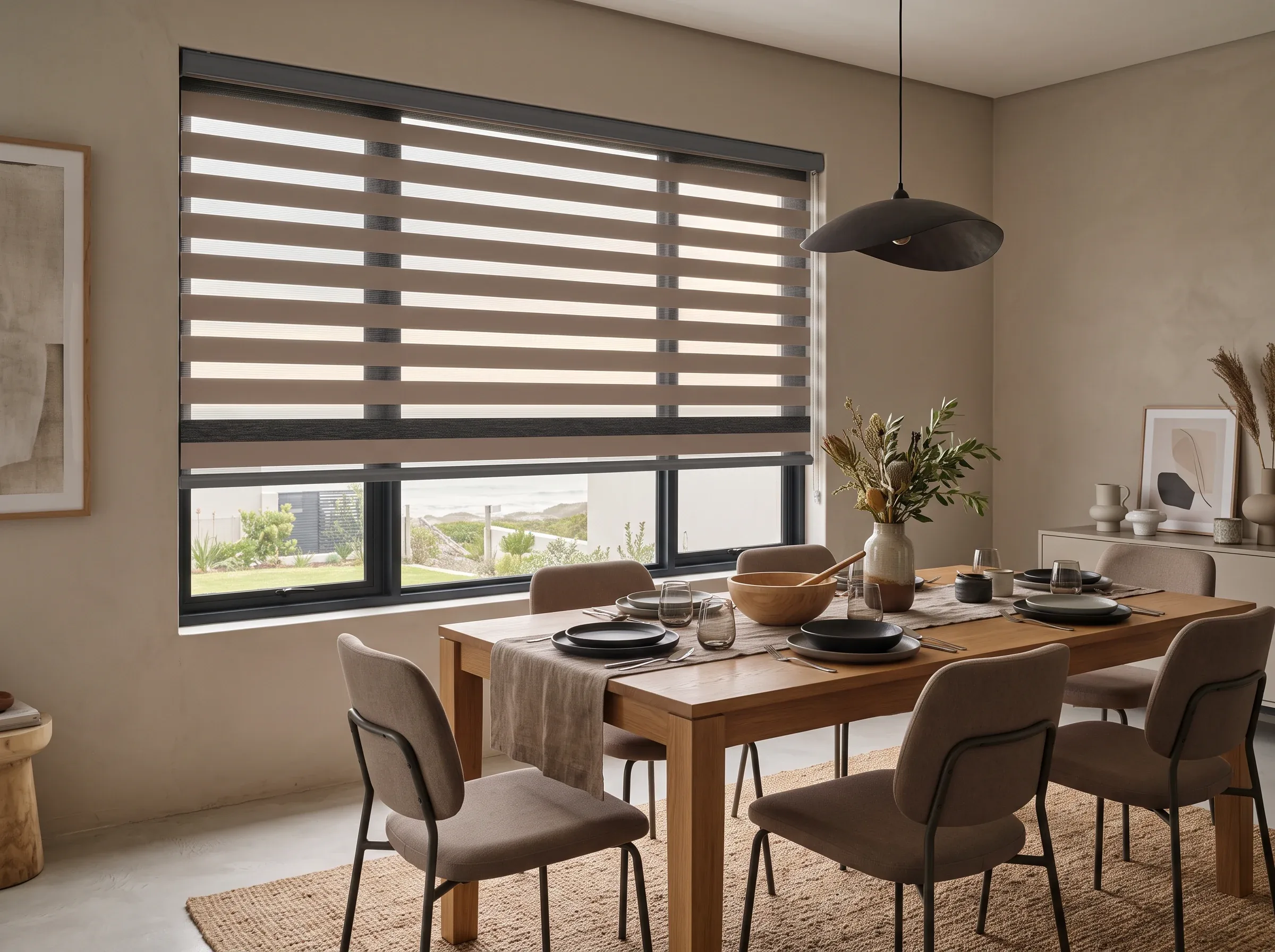
Day and night banded blinds where you want to keep dialling it: the bands offset to give you a clear stripe of garden, or line up to close the room off entirely, and you change your mind twenty times a day at no cost.
Sunscreen mesh rollers on the big living glass, so the garden stays visible and the glare comes off. Vertical or panel blinds on a wide stacking door, because they stack clear of the opening instead of hanging a heavy roll across the head of it.
The honest catch on mesh: a sunscreen fabric is private in one direction only, and only while it is brighter outside than in. After dark with your lights on, it reverses completely — you become the lit side. Anyone who tells you a mesh gives you evening privacy is selling. For rooms used at night, mesh in front and a blockout behind it on the same bracket is the real answer.
The bands offset rather than closed — enough cover to stop the overlooking, with the garden and the wall next door still in view.Four
Upstairs the problem is the whole sky
Go up a flight and the brief flips. A first-floor window in Sunningdale sees everything: no wall opposite, no canopy, no ridge, and a roof space directly above it that has been collecting heat since eleven in the morning. In most double-storey houses here the hottest room in the building is upstairs and on the western half of the plan, and it is hottest at bedtime rather than at noon.
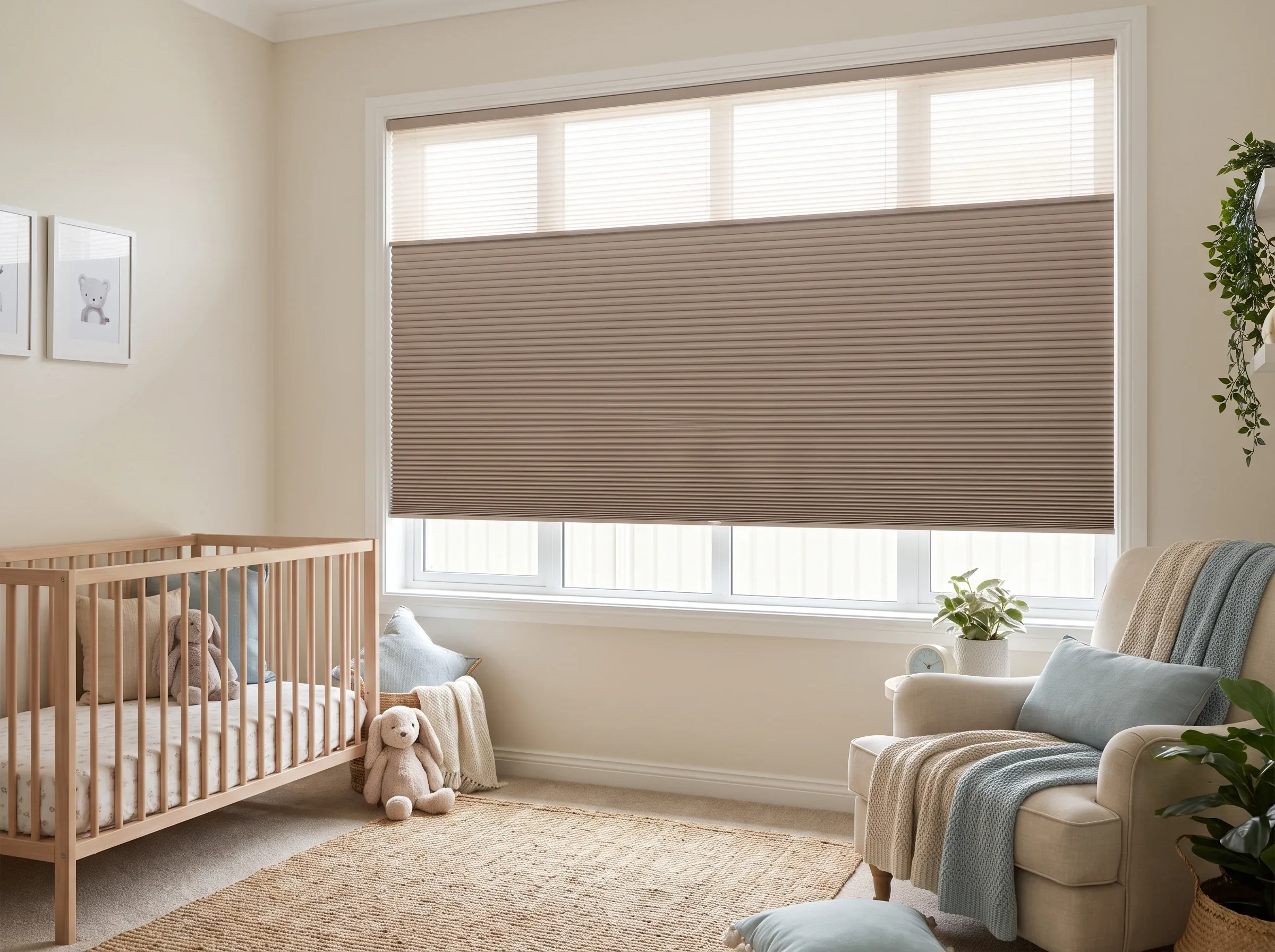
That is where an insulating fabric earns its keep. A cellular honeycomb blind is made of cells that hold a layer of still air between the fabric and the pane. The still air is the insulator; the fabric only keeps it in place. Closed in the reveal it slows the heat coming through a hot pane in the evening, and does the same job in reverse on a cold July night.
What we'd fit upstairs
Cellular honeycomb blinds in bedrooms, nurseries and any first-floor room that is unusable after four. Ordered top-down and bottom-up, the same blind covers the bottom of the window against the street and leaves the top open for sky and air.
A blockout roller where a room simply has to go dark. Worth knowing: every blockout fabric is opaque, so the light that wakes a child at half past five in December is the light coming around the edges. New-build aluminium frames here often have a shallow reveal, which means a blind fitted neatly inside it will leak a bright hairline down both sides. Where real darkness is the point, we would rather run the blind over the whole opening and lose a little of the joinery.
One blind, two jobs — the cellular fabric pulled down over the bright upper panes while the sill line stays open.Five
Catch the heat outside, or don't bother
This is the part of the guide worth reading twice, because it is physics rather than preference. Sunlight passes through glass easily. Once it is inside and has landed on something — a blind, a floor, a couch — it turns into heat, and heat does not pass back out through glass nearly as well. An interior blind on a hard west elevation is therefore working after the fact: it saves your floor and your eyes, and the room still warms up. Intercept the beam before the pane and the glass never heats in the first place.
On the wall that cooks — the west to south-west face, on a suburb this exposed — the honest recommendation is to spend the money outside.
The premium answer, and it lives on the outside of the wall
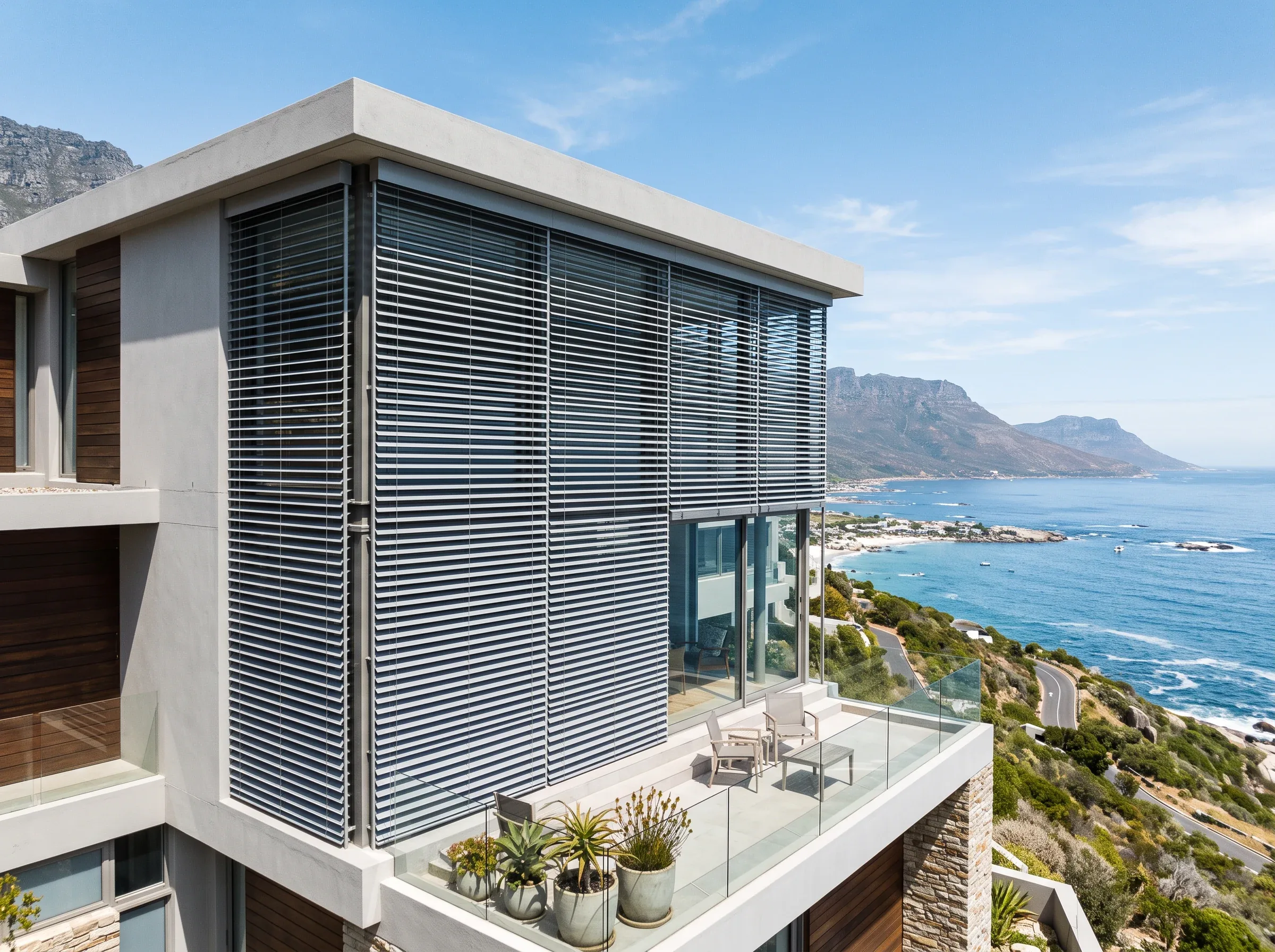
External venetian blinds first. Aluminium slats mounted outside the glass that both raise and tilt, so you steer a low summer beam upward and keep the view underneath it. In winter they raise fully into the headbox and give the north light straight back — which matters here, where you want that light.
Roller shutters where a room wants more: solid slats rolling down over the opening for full shade, an insulating air pocket against the glass, and a noticeable drop in outside noise. To be straight about it, these are shading shutters — sun, heat, glare and privacy. They are not a security-rated product, and we will not pretend otherwise.
Zip screens for the patio. The mesh runs in side channels under tension, so it stays put in a gust instead of flapping, and it turns a covered patio into a room you can actually use on a windy afternoon.
The catch, in full: all three bolt to the outside of your house. That means a real fixing into the structure, a higher price than anything interior, an architectural guideline conversation before you order, and hardware that has to be specified for coastal air. If external is genuinely not possible on your elevation, a sunscreen roller inside the glass is the honest second best — cheaper, and clearly weaker on heat.
Slats tilted rather than closed: the beam is deflected before it reaches the pane, and the room keeps the view out under it.Six
A wind with nothing in its way
The south-easter — the Cape Doctor — blows mainly from October to March, is at its most persistent through November and December, and is strongest in the afternoon once the land has heated up and the pressure difference with the sea has built.4 On a flat coastal plain with young gardens and no mature windbreak, it arrives at your patio essentially undiminished.
That has three practical consequences, and they are the reason a lot of outdoor shading in this suburb fails early.
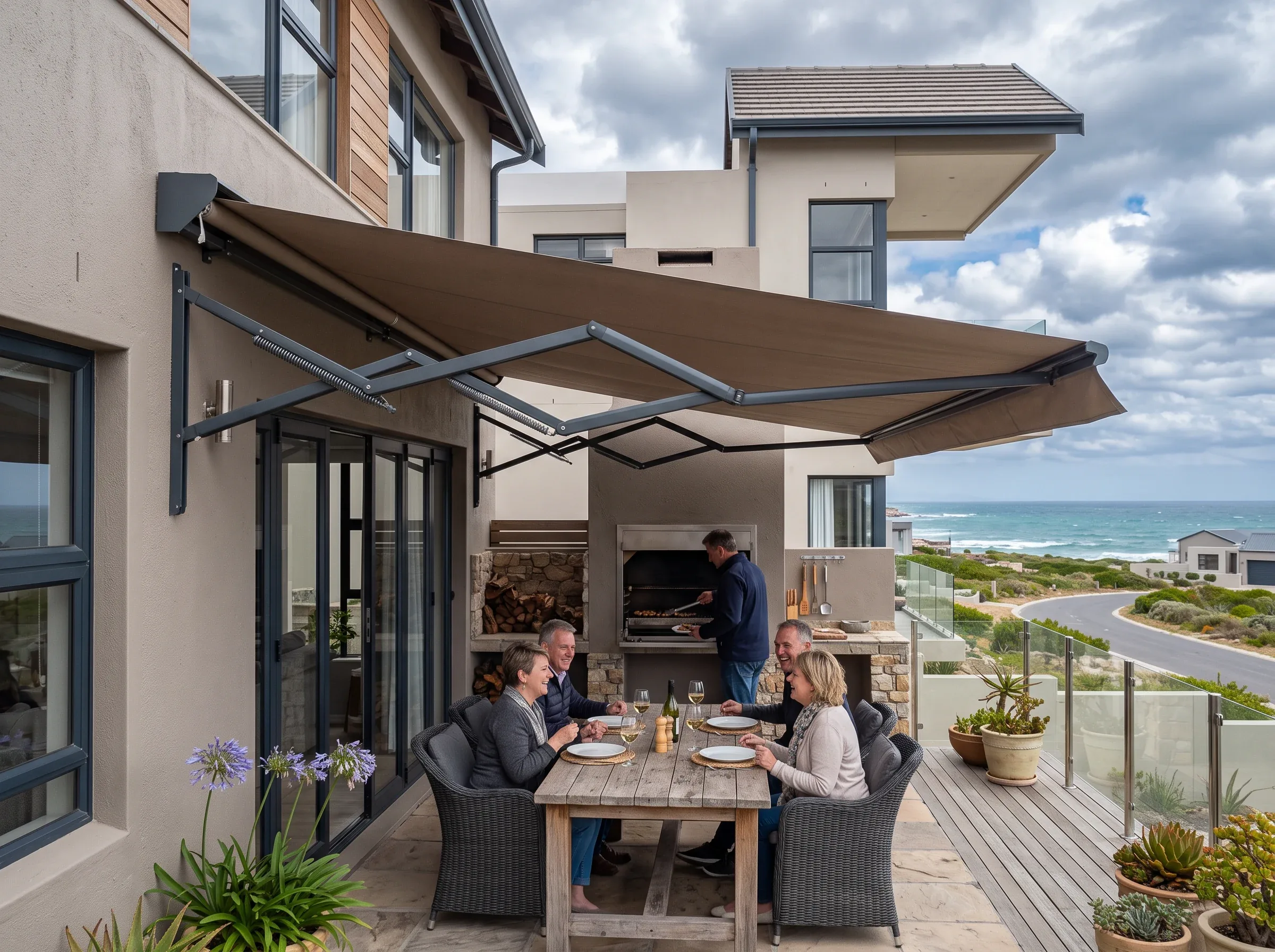
A folding-arm awning is a sail, not a roof. It is a superb shade product and a poor weather product. Specified properly it retracts fully into a closed cassette, and on a motorised unit a wind sensor pulls it in before a gust arrives rather than after the damage. We treat that sensor as standard advice on this coast, not an upsell.
Anything mounted outside needs a wind rating you can ask about. External blinds, screens and awnings all have an operating wind class from the maker. Ask for it in writing on the quote, and ask what happens above it — the honest answer is always "it retracts", never "it copes".
Side channels beat free hems. A screen held in tracks down both edges takes a gust that would fold an unguided one. It is why we push zip screens for exposed patios here and are cautious about a plain drop-down blind in the same position.
Arms out on a grey, still afternoon — the same awning should be wound back in the cassette long before the wind fills it.Seven
Salt, two kilometres back from the water
Let us be accurate rather than dramatic. Sunningdale is not beachfront. You do not get the constant aerosol that a house on the dunes lives with, and you do not need to spend as though you do. But on a hard blowing day salt does travel inland from Table Bay, and it lands on exactly the things that are hardest to replace — the outside of a headbox, the tracks of a screen, the fixings holding it all to the wall.
So the standard we would hold to on any external product here:
Powder-coated aluminium housings and slats, with sealed cassettes rather than open mechanisms.
Stainless or otherwise corrosion-rated fixings. A good blind on ordinary bolts is a good blind for three years.
A hose-down with fresh water two or three times a year on anything outside. It sounds too simple to matter. It is the single cheapest thing that extends the life of exterior hardware anywhere near this coast.
Grit is the real enemy of a screen. Sand blown into a side channel does more damage than salt ever will. Keep the channels clear and a zip screen will run for years.
Eight
Read your phase's guideline before you order
Sunningdale was built in phases, and each one comes with its own architectural guideline document. Those documents generally have something to say about anything that changes the look of a facade — colour, whether an addition may be permanent, and what may hang over a patio.
We are not going to paraphrase yours here, because getting that wrong costs you money. Do this instead: ask your HOA for the current guideline covering your phase before you order anything that shows from the street, and send it to us. We will read it with you and tell you plainly what fits inside it and what does not. Interior blinds are a furnishing decision and touch none of this; awnings, external blinds, screens and shutters do.
What we can promise from our side is a colour-matched, low-key result: fabric and housings matched to your house tone, slim profiles, and drawings and product data supplied so an approval request is easy to submit. What we will not do is tell you an approval is a formality.
Nine
Five things a measure settles and a guide can't
Everything above comes off published data and twenty minutes with a map. These five only come off your actual house:
Which way it really faces. Estate layouts curve, and "we face west" is wrong about as often as it is right. Ten degrees changes which room needs external shading and which does not.
The depth of the reveal. New-build aluminium frames are often set shallow in the wall. A centimetre or two decides whether a blind can sit inside the opening at all, and whether a bedroom will go properly dark.
What the wall is made of behind the plaster. Solid masonry, hollow block or a lighter upper-floor build all take a different fixing — and one of them may not take an external product at all without extra work.
Where the power is. Motorised is the right answer on high or wide glass, but only if there is a supply within reach or a battery tube you can recharge without a ladder every time.
What your guideline allows. Phase by phase, this differs. It is a ten-minute conversation on site and an expensive discovery afterwards.
That is the honest reason the measure is free and unhurried. Every one of those is cheaper to find out before the quote than after the fitting.
Next step
Have someone walk it with you
Tell us which room is unusable and roughly when you'd like it sorted. One of our expert consultants will contact you shortly to arrange a free in-home measure, with fabric and slat samples, and a written per-window quote afterwards.
Every dated or numbered claim above traces to one of these. The product recommendations, the reading of what the sun bearings mean for a Sunningdale wall, and the maintenance advice are our own opinion and are offered free and without obligation.
Garden Cities — Sunningdale (the developer's own account of the suburb: first phases built just over twenty years ago, a pause while city infrastructure caught up, further phases added and homes still under construction, with facilities added as the suburb grows).
Seeff Property Group — Sunningdale, Blouberg area profile (the suburb's position on Cape Town's Western Seaboard, between Table View and Parklands).
Gaisma — Cape Town sun path data (June-solstice altitude at 12:00 about 31° with a sunset bearing near 295°; December-solstice altitude at 12:00 about 75° with a sunset bearing near 240°). The altitudes used on this page are derived from the latitude and the ±23.44° declination at true solar noon; the source's own are clock readings at 12:00.
Wikipedia — Cape Doctor (the south-easterly blows mainly in late spring and summer, roughly October to March, is most persistent in November and December, and is strongest in the afternoon as the land heats).
Nothing on this page is an architectural-approval opinion. Your homeowners' association and its guideline document are the authority on what may be fixed to your facade, and we would always rather read yours than guess at it.